
Contract Manufacturing for White-Label Condensing Units: From OEM Specs to Container-Ready Cold Room Systems
What "Contract Manufacturing" Means in White-Label Condensing Units
A private-label brand owner in the Netherlands had a problem. Their commercial refrigeration brand was selling well into the German small-format retail chain — about 800 condensing-unit-equipped cold rooms per year. The brand owner had always assembled the condensing units themselves, on a leased line in Rotterdam. When the lease came up for renewal, the landlord doubled the rent, the line operator retired, and a single German customer reported a refrigerant leak traced to a batch of brazed joints. The brand owner had two choices: build a new line in-house at a different location, or move the assembly step to a contract manufacturer who would build the same units under the brand's nameplate.
This is what "contract manufacturing" means in the white-label condensing unit context. The contract manufacturer runs the production line, the engineering team, the quality system, the certifications, and the logistics. The brand owner runs the spec, the brand identity, the warranty, and the customer relationship. The compressor, the condenser, the refrigerant, the control panel, the cabinet artwork, and the serial number all flow through the contract manufacturer's facility — but the brand is the one the customer sees.
The term is not the same as private-label manufacturing for consumer goods (where the contract manufacturer owns the recipe and the brand owner just buys and re-sells), nor is it the same as original design manufacturing (ODM, where the contract manufacturer also designs the product). In the white-label condensing unit space, the brand owner usually supplies the spec — cooling capacity, voltage, refrigerant, cabinet colour, certification scope — and the contract manufacturer turns the spec into a buildable engineering BOM. The product is engineered for the brand, manufactured by the contract manufacturer, and sold under the brand.
Step 1: Translating Your Brand Spec Sheet into an Engineering BOM
The first step in any white-label project is the conversion of the brand's spec sheet into an engineering bill-of-materials (BOM) the OEM can build to. The spec sheet is usually a one-page document drafted by the brand's product manager. The engineering BOM is usually a ten-to-fifteen-page document drafted by the OEM's engineering team. The two must reconcile before production starts, because every item on the BOM has a lead time, a cost, and a certification implication.
The minimum items the brand must supply are: cooling capacity in kW or refrigeration tons at a stated ambient condition (for example, 8.5 kW at 0 °C evaporating and 35 °C ambient), refrigeration temperature range (medium-temp 0 to -10 °C, low-temp -25 to -40 °C, blast-freezing -40 °C and below), voltage and frequency (single-phase 230V/50Hz, three-phase 380V/50Hz, three-phase 460V/60Hz, or others), refrigerant (R404A, R448A, R290, R744), noise limit in dB(A) measured at one metre, cabinet colour (RAL code), branding artwork (logo file, nameplate file), and certification scope required by the destination market (CE for EU, UL/ETL for North America, ISO 5149 for flammable refrigerants, KC for South Korea, CCC for China, INMETRO for Brazil).
Two items on the spec sheet are the most common source of project delay. The first is the ambient condition — a brand that writes "suitable for tropical conditions" without naming the ambient will find that the OEM has to assume either 35 °C or 46 °C, and the resulting compressor and condenser sizing will differ by 30 percent. The second is the certification scope — a brand that omits UL/ETL will find the control panel has to be re-engineered for the North American market, adding six weeks and several thousand dollars per SKU.
Step 2: Compressor, Condenser and Refrigerant Configuration
Once the engineering BOM is locked, the OEM locks the three central design choices that determine the unit's performance and service life: compressor type, condenser configuration, and refrigerant. Each choice has downstream implications for service infrastructure in the destination market, and each choice is reversible only at significant cost.
Compressor type
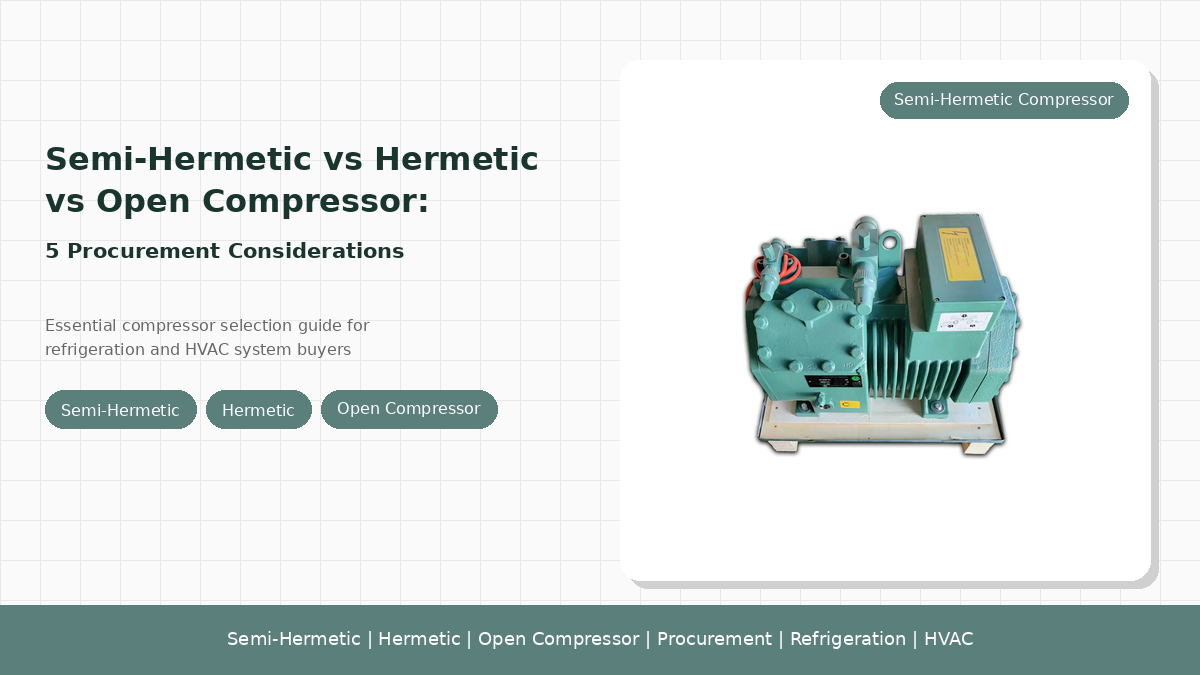
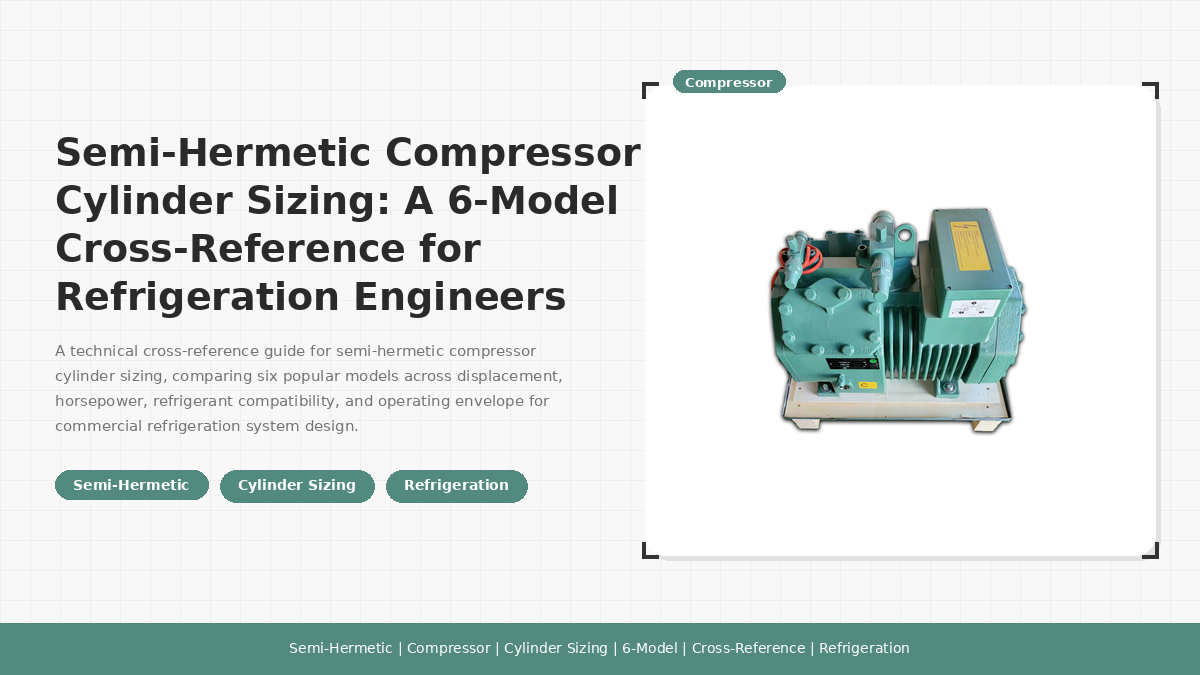
For medium-temp applications (0 to -10 °C evaporating), the most common choices are hermetic reciprocating compressors for units under 5 kW, semi-hermetic reciprocating compressors for 5 to 25 kW, and semi-hermetic screw compressors for 25 kW and above. For low-temp applications (-25 to -40 °C evaporating), semi-hermetic reciprocating compressors dominate 5 to 20 kW, and semi-hermetic screw compressors dominate 20 kW and above. Brand owners whose customers are in regions with mature service infrastructure (Europe, North America) can specify any major compressor brand. Brand owners whose customers are in regions with limited service infrastructure should specify the compressor brand with the deepest local dealer network, even if the unit price is higher.
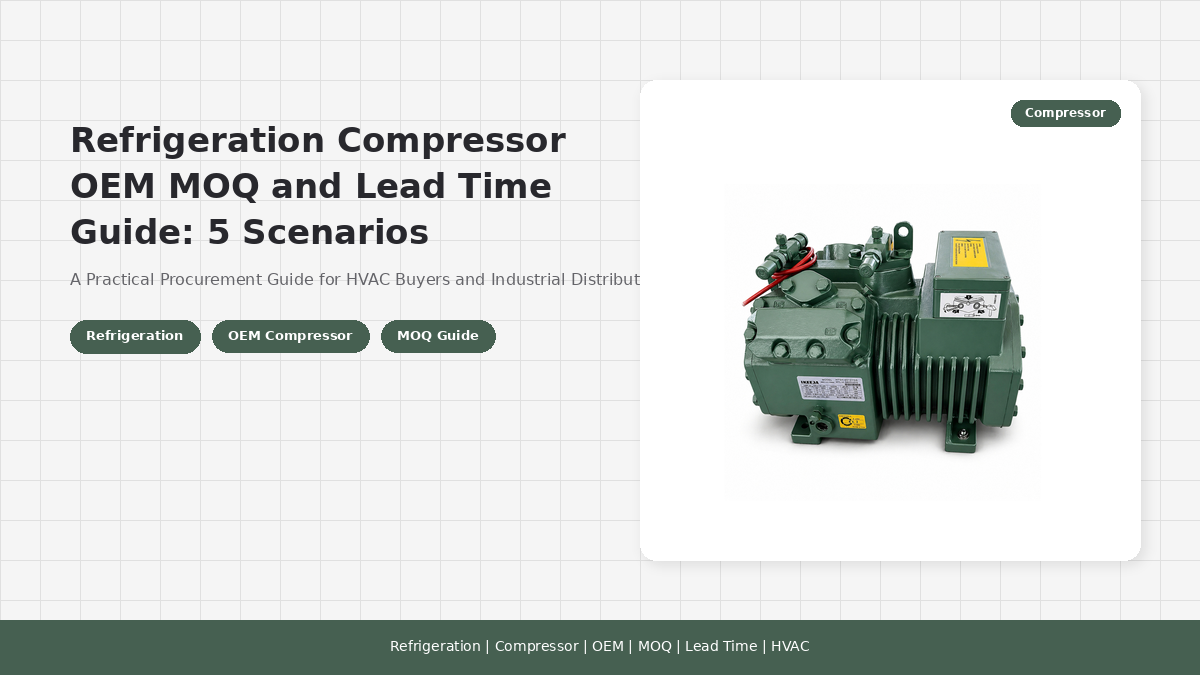
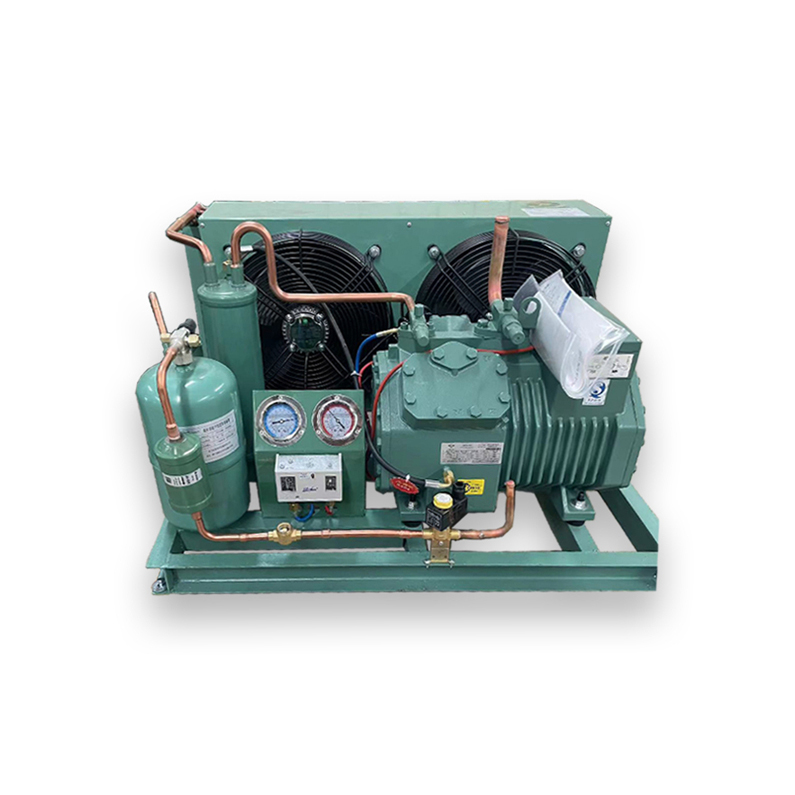
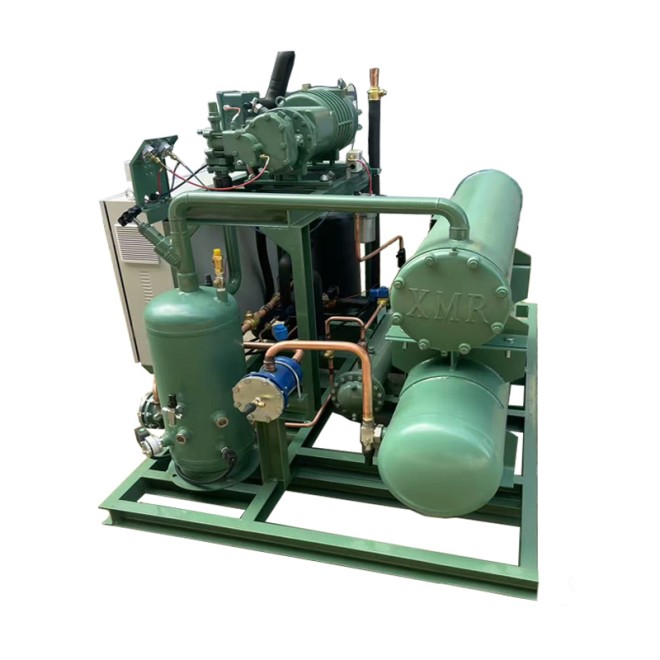
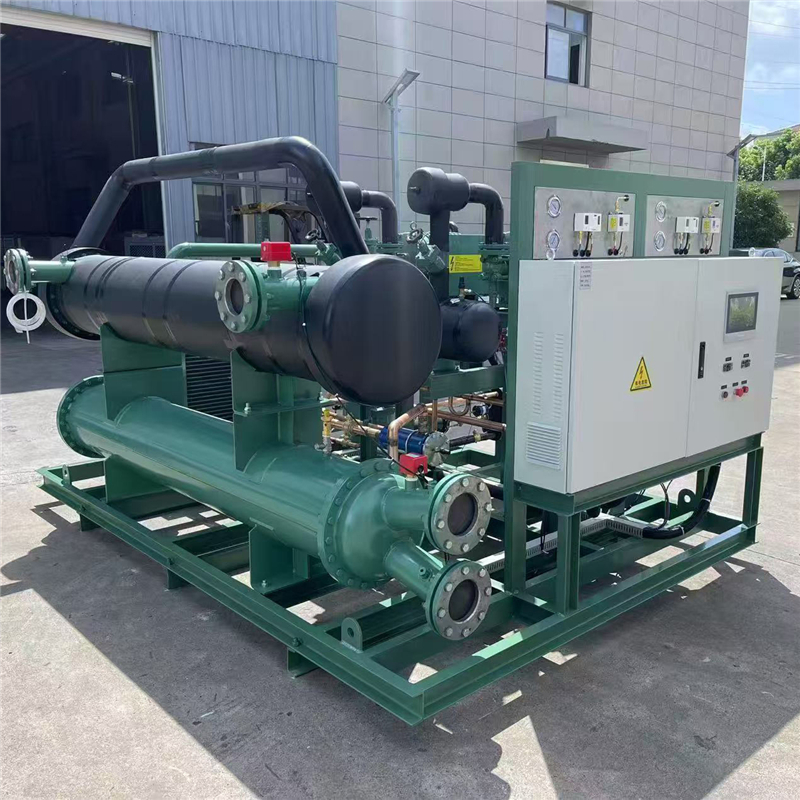
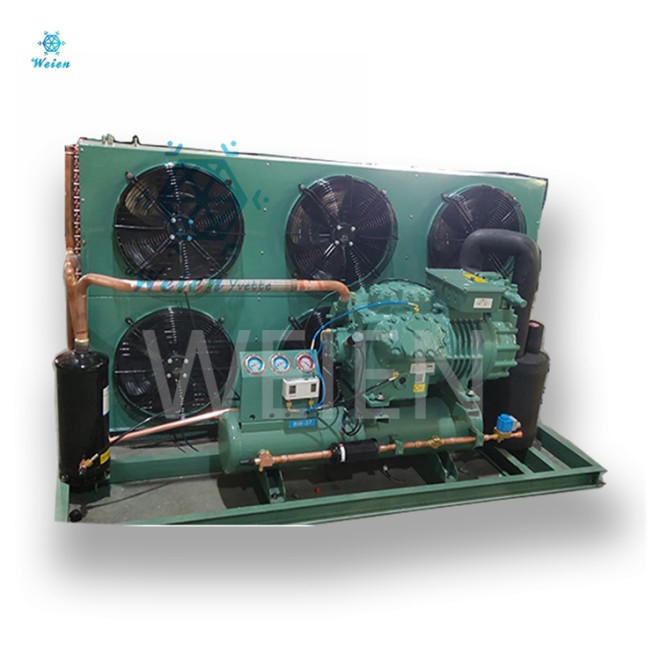
The compressorweien.com condensing unit range covers screw compressor condensing units in water-cooled and air-cooled configurations, with copper-coil condensers and OEM-spec compressor models, designed for cold-room and industrial refrigeration. Sizing is matched to the brand's spec sheet at the BOM stage.
Condenser configuration
Air-cooled condensers are the default for most white-label condensing units, because they have no on-site plumbing and the brand's installer can mount the unit on a wall bracket or roof frame. Water-cooled condensers are preferred when the installation site has chilled water available year-round (process plants, marine applications, indoor cold rooms with a chiller loop). Evaporative condensers sit in the middle: more efficient than air-cooled, less efficient than water-cooled, but they require a water supply and a water-treatment regime that many small-format retail chains do not have.
Refrigerant
R404A remains the most commonly specified refrigerant for white-label condensing units exported to markets without HFC phase-down pressure, because the global service infrastructure is mature and compressor availability is widest. For markets under HFC phase-down (EU F-Gas, California, Japan, Australia), the shift is toward R448A as a low-GWP R404A replacement, R290 (propane, GWP 3, subject to charge-size limits per IEC 60335-2-40), and R744 (CO2, used in transcritical booster systems for low-temperature cold rooms). The right answer depends on the destination market's regulatory environment and on the brand's service-parts inventory plan.
For an overview of how the key components in a refrigeration compressor fit together and what each function does, the compressorweien.com key components reference is a useful internal document the brand's engineering team can share with the OEM during the BOM review.
Step 3: Private-Label Branding, Stickering and Serial Numbering
Once the engineering BOM is locked and the compressor and condenser are chosen, the brand-specific production steps begin. These are the steps that turn a generic OEM build into a brand-owned product in the eyes of the customer: nameplate artwork, cabinet colour, cabinet sticker placement, and serial-number assignment.
Nameplate artwork is the highest-risk branding step. The nameplate is the document the regulatory inspector, the warranty engineer, and the service technician all read first. If the nameplate carries the wrong voltage, the wrong refrigerant charge, or the wrong CE/UL marking, the unit can be refused at customs, refused at the installer's site, or refused at the first warranty claim. The brand must supply the nameplate artwork in vector format (AI or EPS), and the OEM must verify the artwork against the destination market's regulatory template before the first unit is produced.
Cabinet colour is usually a single RAL reference. The OEM's standard cabinet colour is RAL 7035 (light grey); most brand colours can be matched with a powder-coat change. Dark colours (RAL 9005 black, RAL 8017 brown) absorb more solar heat and may push the condenser design margin; the brand should expect a longer lead time and a small cost premium for dark cabinet colours.
Serial numbering is the single most important traceability step in a white-label project. The brand assigns a serial-number range — typically a numeric block of one thousand to ten thousand units — and shares the range with the OEM. The OEM stamps each nameplate within the range during production and returns a serial-number register at the end of each batch. The register maps each serial number to the production date, the compressor serial number, the refrigerant batch number, the operator ID, and the PSAT outcome. This document is what the brand needs for warranty claims, regulatory recall, and downstream traceability if a problem is discovered in the field.
Step 4: Pre-Shipment Acceptance Test (PSAT) at the Container Level
The pre-shipment acceptance test (PSAT) is the single most important step in white-label risk control. PSAT shifts verification from the buyer's site to the OEM's site, where correction is cheapest. The standard PSAT covers five checks, all run at the OEM's facility before the loaded container leaves the factory:
- Visual inspection against the brand artwork. Each unit is checked against a printed sample of the brand's cabinet artwork, nameplate, and serial number. The check is performed by a trained operator using a checklist signed off by the brand before the first production batch.
- Nameplate verification against the spec sheet. Every nameplate is verified for the correct voltage, refrigerant, cooling capacity, CE/UL marking, and serial number. Nameplate errors are the most common cause of customs delays; PSAT catches them before the container is sealed.
- Serial-number traceability record. The OEM generates a serial-number register mapping each unit to its compressor serial number, refrigerant batch, and production date. The register is shared with the brand at the end of the batch.
- Refrigerant leak test on every unit. Each unit is pressurised with dry nitrogen or a helium-nitrogen mix and held for a minimum of ten minutes; any pressure drop flags the unit for rework. The leak test catches the brazed-joint failures that caused the German customer's complaint in the opening example.
- Electrical safety check on the control panel. Each control panel is powered up and tested for insulation resistance, earth continuity, and correct compressor rotation. Electrical safety failures are caught at the OEM's site rather than at the buyer's installer site.
PSAT should be specified in the supply contract, not added later as a goodwill gesture. The cost of a five-check PSAT is small per unit; the cost of finding a nameplate error at the destination port is large.
Step 5: Container-Ready Cold-Room Integration and Logistics
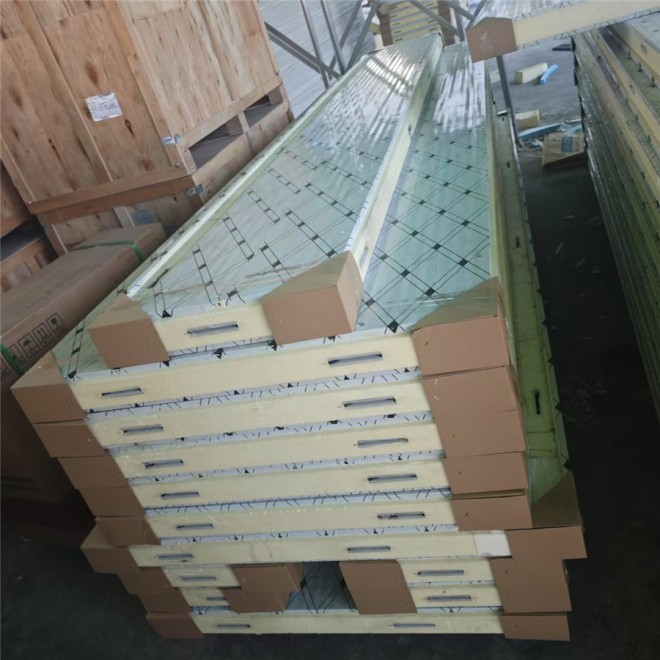
The final engineering step is container-ready cold-room integration. The objective is to ship the condensing unit and the cold-room panels in the same container, with cut-outs and cable glands pre-positioned so the buyer's installer mounts the unit, bolts the panels, and connects a single power feed. Done correctly, this is a half-day per cold-room at the installer's site rather than two days of loose-unit assembly.
The integration work happens at the OEM's facility, not at the installer's site. The OEM's cold-room team fabricates the panels to match the condensing unit's footprint, cuts the cable gland positions to match the control panel's entry points, and packages the panels in a sequence that matches the installer's assembly order. The condensing unit is mounted on a wooden base or a steel skid that is forklift-friendly at the destination port.
Logistics for container-ready integration has four common shipping configurations. (1) A 20-foot container for small-format cold rooms (under 30 m²) with a single condensing unit per container. (2) A 40-foot high-cube container for medium-format cold rooms (30 to 80 m²) with two or three condensing units per container. (3) A 40-foot high-cube container for large-format cold rooms (over 80 m²) with a single condensing unit and panel kits for assembly at the destination site. (4) A flat-rack container for oversize condensing units (semi-hermetic screw units above 60 kW) that exceed standard container dimensions.
The OEM's logistics team should share the container-loading plan with the brand before the container is sealed, including the unit positions, the panel sequence, and the cable gland alignment. The plan becomes the installer's reference document at the destination site.
SOP Checklist: 10 Items to Verify Before You Sign the Contract
Before the brand signs a white-label contract manufacturing agreement, ten items must be on the table. The list is short and rules-driven; the negotiation is usually about whether the OEM can commit to each item in writing.
| # | Item | What to verify |
|---|---|---|
| 1 | Compressor brand and model | OEM commits to a specific compressor brand/model with documented local service support |
| 2 | Refrigerant and charge size | OEM commits to the refrigerant and charge size in writing; flammable-refrigerant units must comply with IEC 60335-2-40 |
| 3 | Certification scope | OEM commits to CE / UL / ETL / KC / CCC as required by the destination market, including the certificate numbers |
| 4 | Ambient design margin | OEM confirms the design ambient (35 °C or 46 °C or other) in the spec sheet |
| 5 | Serial-number range and register | Brand assigns the range; OEM commits to returning a serial-number register at the end of each batch |
| 6 | PSAT scope | OEM commits to the five-check PSAT and accepts rework cost for any failure |
| 7 | Lead time per batch | OEM commits to a fixed lead time (typically 25 to 45 days from PO to container loaded) |
| 8 | MOQ per SKU | OEM confirms MOQ (typically 20 to 50 units per SKU per batch) |
| 9 | Warranty terms | OEM commits to compressor warranty (typically 24 to 36 months) and full-unit warranty (typically 12 months) |
| 10 | Spare-parts supply | OEM commits to spare-parts supply for at least five years post-delivery, including valves, controllers and compressor spare parts specific to the build configuration |
Items 1, 4 and 6 are the three most common sources of post-contract disputes. Item 1 (compressor brand and model) determines whether the brand's customers can service the unit locally; an OEM that swaps the compressor mid-batch without notice destroys the brand's service infrastructure. Item 4 (ambient design margin) determines whether the unit can perform at the destination's peak summer ambient; a unit designed at 35 °C and installed at 46 °C will trip on high-pressure cut-out. Item 6 (PSAT scope) determines whether the brand finds out about nameplate or leak failures at the OEM's site or at the destination port.
When White-Label Manufacturing Beats In-House Assembly
The BOFU decision is whether white-label contract manufacturing beats in-house assembly. The decision is usually made on three dimensions: production volume, engineering depth, and capital exposure. The table below summarises the typical decision logic; the final call must always include the brand's specific production forecast, engineering team size, and balance-sheet constraints.
| Brand profile | Recommendation | Reasoning |
|---|---|---|
| Production volume under 1,000 units per year | Standardise on contract manufacturing | In-house assembly line capex cannot be amortised at this volume; white-label converts fixed cost into variable cost |
| Production volume 1,000 to 5,000 units per year | Hybrid: contract manufacture the standard SKUs, in-house assemble the customised SKUs | Standard SKUs benefit from OEM scale; customised SKUs benefit from in-house engineering speed |
| Production volume over 5,000 units per year | In-house assembly line + OEM for overflow | In-house capex is amortised; OEM handles demand spikes |
| Engineering team under 5 engineers | Standardise on contract manufacturing | The brand cannot maintain a full-time quality engineer, process engineer and certification engineer at this team size |
| Engineering team over 20 engineers | In-house assembly + OEM overflow | The brand can run the quality and certification work in-house; OEM handles overflow |
| Capital constrained (capex denied) | Standardise on contract manufacturing | White-label is opex; in-house is capex |
| Multiple compressor models across multiple destinations | Hybrid: OEM for non-core destinations, in-house for core destination | OEM flexibility for low-volume destinations; in-house control for high-volume destinations |
The general principle is straightforward: white-label contract manufacturing is the lower-total-cost option for brands producing fewer than a few thousand units per year, with small engineering teams, and with capital constraints. As production volume rises and the engineering team grows, the balance shifts toward in-house assembly, with the OEM retained for overflow and for non-core destinations. For a project-specific conversation about which configuration fits a brand's profile, contact the Compressor Weien engineering team with the brand's spec sheet and production forecast in hand.
Send your brand spec sheet (cooling capacity, voltage, refrigerant, certification scope, artwork). The Compressor Weien engineering team replies within one business day with a BOM, lead time, and unit-price indication.
Frequently Asked Questions
What does contract manufacturing actually cover in a white-label condensing unit?
Contract manufacturing in a white-label condensing unit covers the full production chain the private-label brand does not run in-house: compressor selection and procurement, condenser/evaporator coil fabrication, refrigerant circuit assembly, electrical control panel build, pressure and leak testing, brand-specific stickering and serial numbering, packaging, and container loading. The brand owner supplies the spec sheet and the brand identity; the contract manufacturer supplies the engineering, the production line, the certifications, and the logistics.
What BOM details must the private-label brand provide before production starts?
The brand must supply cooling capacity (kW or TR at a stated ambient), refrigeration temperature range, voltage and frequency (for example 380V/3-phase/50Hz or 460V/3-phase/60Hz), refrigerant preference (R404A, R448A, R290, R744, or another), noise limit in dB(A) at one metre, cabinet colour, branding artwork, and any certification scope required by the destination market (CE, UL, ETL, ISO 5149 for flammable refrigerants). Without these inputs the contract manufacturer cannot lock the engineering BOM and the production schedule slips.
What is a pre-shipment acceptance test (PSAT) at the container level?
A pre-shipment acceptance test at the container level is a structured set of five checks run before the loaded container leaves the OEM factory. The standard PSAT includes visual inspection against the brand artwork, nameplate verification against the spec sheet, serial-number traceability record, refrigerant leak test on every unit, and an electrical safety check on the control panel. PSAT is the single most important step in white-label risk control because it shifts verification from the buyer's site to the OEM's site, where correction is cheapest.
How is the brand's serial number range assigned and tracked across batches?
The brand assigns a serial-number range, typically a numeric block of one thousand to ten thousand units, and shares the range with the contract manufacturer. The OEM stamps each nameplate within the range during production and returns a serial-number register at the end of each batch. The register maps each serial number to the production date, the compressor serial number, the refrigerant batch number, and the PSAT outcome. This is the document the brand owner needs for warranty claims, regulatory recall, and downstream traceability.
How does the OEM handle compressor sourcing if a brand specifies a non-standard model?
If the brand specifies a compressor model outside the OEM's standard stocking list, the contract manufacturer sources the compressor through authorised channels, verifies the compressor serial number against the manufacturer's published range, and includes the compressor serial number in the brand's unit-level traceability record. Lead time and minimum order quantity for the non-standard compressor are shared with the brand before the BOM is locked, so the brand can decide whether to switch to an equivalent standard model or to accept the longer lead time.
Why do private-label buyers insist on container-ready cold-room integration rather than loose units?
Container-ready cold-room integration reduces the buyer's on-site assembly hours, lowers the risk of field wiring errors, and gives the buyer a single point of contact for warranty instead of two or three. The condensing unit arrives pre-piped, pre-wired, pre-charged with refrigerant, and labelled with the brand artwork; the cold-room panels arrive with cut-outs and cable glands that match the condensing unit's footprint. The buyer's installer mounts the unit, bolts the panels, and connects a single power feed — typically a half-day per cold-room rather than two days.
Which refrigerant configuration is most often white-labeled for export markets?
R404A remains the most commonly specified refrigerant for medium-temperature white-label condensing units exported to markets without HFC phase-down pressure, because the global service infrastructure is mature and compressor availability is widest. For markets under HFC phase-down (EU, California, Japan), the shift is toward R448A (low-GWP R404A replacement), R290 (propane, GWP 3, subject to charge-size limits per IEC 60335-2-40), and R744 (CO2, used in transcritical booster systems for low-temperature cold rooms). The right answer depends on the destination market's regulatory environment.
Is white-label contract manufacturing more expensive than direct OEM assembly in-house?
Unit cost for white-label contract manufacturing is usually 10 to 20 percent higher than a brand running its own assembly line, because the OEM's overhead and engineering effort are baked into the unit price. The total cost of ownership, however, is usually lower: the brand avoids capex on a dedicated assembly line, avoids the fixed cost of a quality engineer and a process engineer, and converts fixed cost into variable cost per batch. For brands producing fewer than a few thousand units per year, white-label is almost always the lower total-cost option.
About the Author
References and Industry Resources
The following resources were used to support the contract manufacturing analysis in this article. They are industry-association and standards references, not the underlying ISO/UL/CE documents themselves. For exact standard text, refer to the regulatory authority directly.
- Air-Conditioning, Heating, and Refrigeration Institute (industry standards and certification for HVAC/R): AHRI
- American Society of Heating, Refrigerating and Air-Conditioning Engineers (technical standards and guidance): ASHRAE
- European HVAC certification and rating programme: Eurovent Certification
- US Environmental Protection Agency refrigerant regulations (Section 608, HFC phase-down): EPA Section 608
- Refrigeration controls and components global supplier: Danfoss