
Manufacturer Partnerships for Private-Label Cold Storage: Brand Owners and Custom Condensing Unit Development
A procurement director at a North American cold-chain brand owner opened her inbox on a Monday morning and counted 12 RFQ responses for a private-label cold storage condensing unit program. Three factories had quoted 40% below the median price, three were within 5% of the median, and the remaining six clustered between 10-25% below median with longer lead times. She had six weeks to decide which factory would actually deliver the custom condensing unit her brand promised its retail customers. This is the field-tested version of how an independent brand owner should run that audit — and what to do differently the second time around.
This guide is built around the manufacturer-partnership qualification workflow used by independent brand owners sourcing custom condensing units from Chinese ODM factories like Xinchang Weien Import & Export Co., Ltd. — a sourcing hub for refrigeration equipment and spare parts that supports Bitzer, Copeland, Carrier, and Thermo King compressor platforms on a single condensing unit footprint, with engineering capability for custom badging, OEM platform configuration, and private-label carton design.
The 6-week RFQ audit that exposed the private-label factory gap
The 12-factory RFQ audit pattern above is not unusual. Independent brand owners in cold storage typically see three factory types in their RFQ response pool. Type A is the OEM-branded compressor manufacturer or its authorized assembler — these factories quote at the top of the price band (15-30% above median), offer 12-16 week lead times, and have full certification documentation but rarely accept private-label work below 500-unit MOQ. Type B is the serious ODM condensing unit factory — these factories quote in the middle of the price band, offer 8-12 week lead times, support the 4-brand compressor platform configuration, and accept 50-500 unit MOQ with custom badging. Type C is the trading company or relabeler — these factories quote at the bottom of the price band (20-40% below median), offer 4-6 week lead times, but do not have actual production lines and will subcontract the manufacturing to a Type B factory at a higher price, pocketing the margin.
The procurement director's audit identified 2 Type A factories, 4 Type B factories, and 6 Type C trading companies in her RFQ pool. The 3 factories that quoted 40% below median were all Type C trading companies. When she asked for factory audit photos, ISO 9001 documentation, and compressor platform engineering drawings, the Type C factories could not provide them — they sent stock photos and asked for a 7-day grace period to "coordinate with the production line". The Type B factories provided factory audit photos within 24 hours, sent ISO 9001 + CE + PED certificate copies, and responded to the compressor platform engineering questions within 48 hours. The decision was effectively made in week 2 of the 6-week audit, even though the formal RFQ scoring matrix took the full 6 weeks to complete.
The lesson for the second-time-around brand owner is that the factory type can be identified in the first 5 days of the RFQ response by asking four specific questions: (1) "Can you send factory audit photos dated within the last 90 days?" — Type C cannot; (2) "What is your in-house surface treatment capability?" — Type C usually says "outsourced"; (3) "Can you provide a cross-section drawing of the condenser coil?" — Type C sends a brochure photo; (4) "What is your compressor platform standardization program?" — Type C says "any brand as customer requires" without naming the engineering depth. The 4-question triage reduces the 12-factory pool to 4-5 serious candidates in the first week, and the remaining 5 weeks can be spent on engineering depth and pricing negotiation rather than factory-type screening.
What independent brand owners actually buy (vs what resellers buy)
Independent brand owners and resellers buy the same condensing unit hardware at different specification levels, and the difference matters when evaluating which factory is the right partner. Resellers buy on three criteria: stock availability, price competitiveness, and delivery speed. Independent brand owners buy on three different criteria: customization depth, certification stack, and engineering support through the private-label program. Factories optimized for reseller channels (Type B at the high-volume end, Type C at the low-volume end) typically fail on at least one of the brand-owner criteria. The table below summarizes the difference.
| Procurement criterion | Reseller channel | Independent brand owner |
|---|---|---|
| Primary buying driver | Stock availability + price competitiveness + delivery speed | Customization depth + certification stack + engineering support |
| MOQ expectation | 1-10 units per SKU, multi-SKU orders | 50 units trial + 200-500 units launch, single-SKU orders |
| Lead time tolerance | 1-3 weeks (stock pull) | 8-12 weeks (custom build + FAT) |
| Custom badging required? | Rarely (reseller's brand stays off the unit) | Always (private-label badge, color, packaging, manual) |
| Compressor platform lock-in | Single brand (typically whatever is in stock) | Multi-brand (Bitzer / Copeland / Carrier / Thermo King configured to market) |
| Certification documentation | CE only (basic EU compliance) | CE + PED + F-Gas + EN 378 (EU) / UL 1995 + AHRI 520 (NA) |
| Engineering interface | Sales person + WhatsApp | Engineering team + weekly calls + drawing reviews |
| After-sales support | Return-and-replace | Spare parts supply + on-call engineering + FAT documentation |
The procurement criterion difference drives
For OEM procurement teams requiring authoritative reference for the surface roughness grade system and certification framework on private-label condensing units, the BS EN ISO 21920 surface texture standard defines the Ra grade measurement methodology and the UL HVAC and refrigeration certification programme provides the safety listing required for North American distribution of private-label condensing units above 5 HP. the factory-type selection. Type C trading companies are excellent for reseller channels because they have stock, low prices, and fast delivery. They are wrong for brand-owner channels because they cannot support customization depth, certification stack, or engineering interface. The brand-owner factory selection should focus exclusively on the Type B ODM factories with documented multi-brand compressor platform capability, in-house surface treatment, and engineering team for FAT. The 4-6 candidates that survive the 4-question triage in week 1 are typically all Type B factories, and the 5-week selection process becomes a depth-comparison exercise rather than a type-screening exercise.
The second mistake brand owners make is treating the 50-unit trial order like a reseller order. The 50-unit trial order should be used to validate the engineering support, the FAT process, the certification documentation quality, and the spare parts supply chain — not to validate the unit price. The unit price on the 50-unit trial order is typically 10-15% higher than the 500-unit launch order because the factory is amortizing the engineering setup across a smaller lot. Brand owners who push for the lowest 50-unit trial price end up with a factory that has cut corners on engineering support or FAT documentation, and the resulting launch order (200-500 units) inherits the corner-cutting. The 50-unit trial order should be evaluated on the total cost of partnership, not the per-unit price.
The 4 brand-compatible condensing unit platforms brand owners actually evaluate
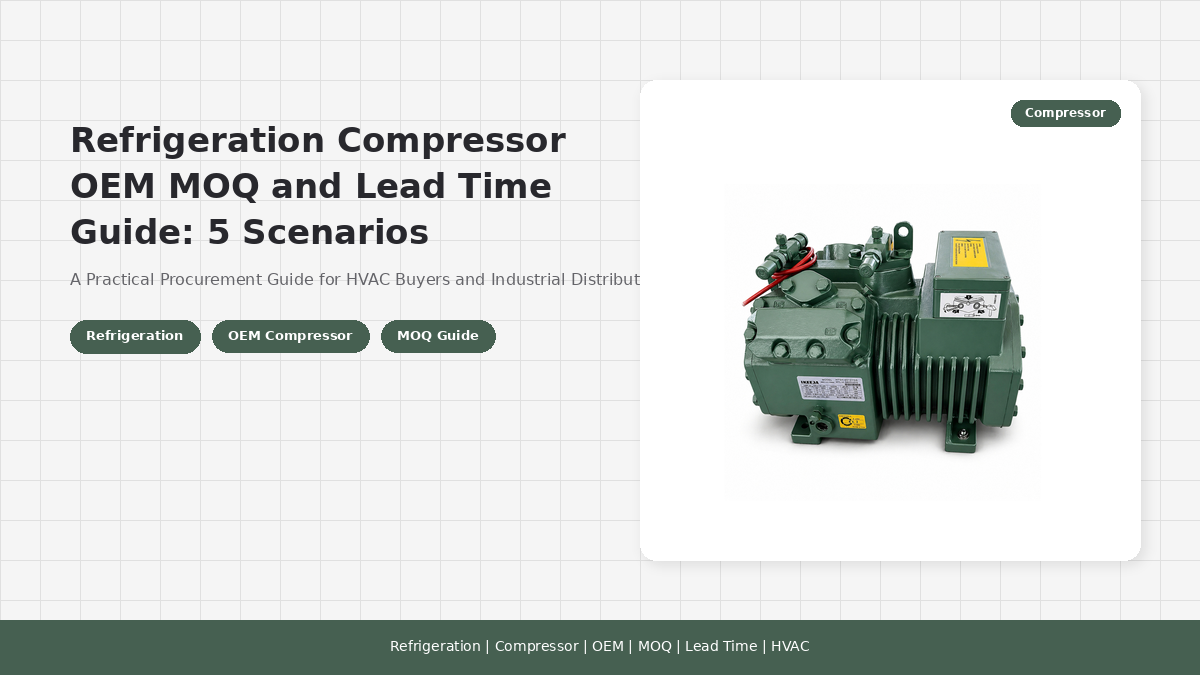
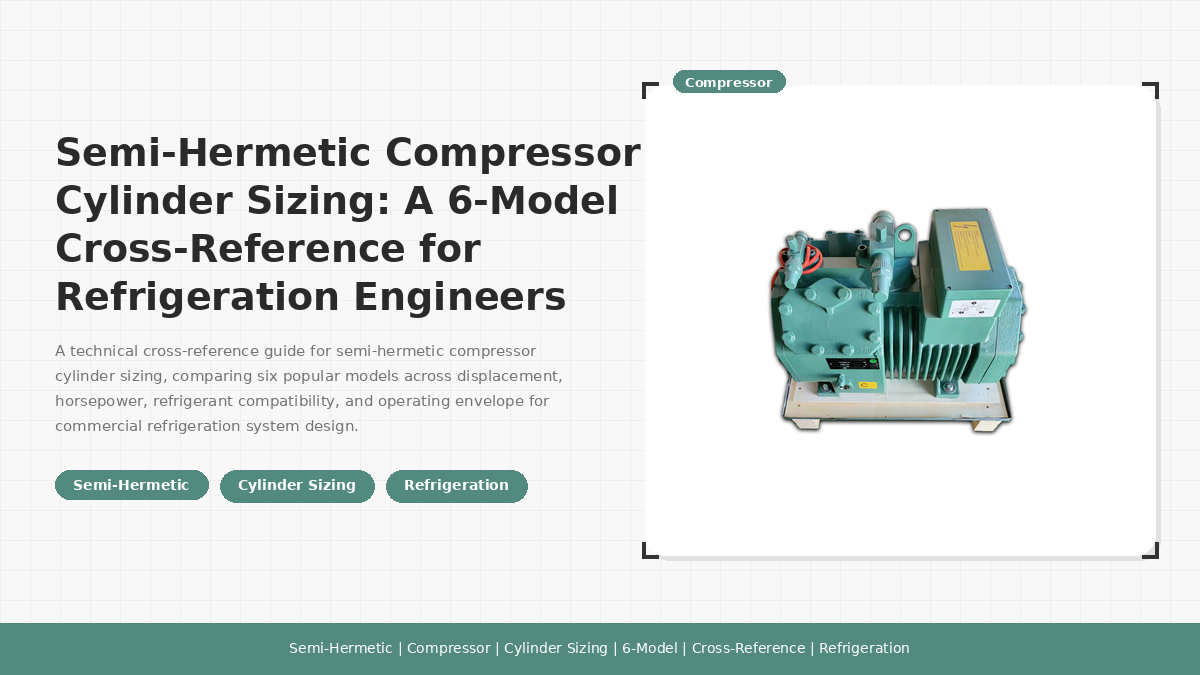
Independent brand owners in cold storage typically evaluate condensing units on one or more of four compressor platforms: Bitzer, Copeland, Carrier, and Thermo King. Each platform has a regional dominance pattern and a typical application sweet spot. A serious ODM partner should be able to configure any of the four platforms on the same condensing unit footprint, because the condenser coil, fan assembly, receiver tank, and chassis are compressor-platform-agnostic. The variation between platforms is the compressor mounting footprint, the discharge piping geometry, and the electrical control box wiring — these are 2-3 week engineering variations on a stock chassis, not a 12-week re-engineering exercise. The table below summarizes the four platforms.
| Platform | Compressor type | Regional dominance | Application sweet spot | Lead time on stock chassis |
|---|---|---|---|---|
| Bitzer (German) | Semi-hermetic reciprocating, screw | EU import markets, Middle East, parts of Asia | Cold storage 5-40 HP, cold room, process cooling | 4-6 weeks |
| Copeland (formerly Emerson, US) | Hermetic scroll, semi-hermetic reciprocating | North American distribution, Latin America, Australia | Cold storage 3-25 HP, supermarket, food service | 2-4 weeks |
| Carrier (US) | HPC/HHN series hermetic reciprocating | Latin America, Middle East, Asia cold chain | Cold storage 5-30 HP, cold room, distribution center | 3-5 weeks |
| Thermo King (US, transport refrigeration focused) | Transport-specific reciprocating and scroll | Global reefer truck and container | Transport refrigeration 2-15 HP, reefer truck, container | 3-5 weeks |
The platform selection matters because the brand owner's target market determines which platform the condensing unit must support. A brand owner targeting EU import should default to Bitzer (with PED 2014/68/EU pressure equipment compliance already on the compressor nameplate). A brand owner targeting North American distribution should default to Copeland (with UL 1995 / CSA C22.2 No. 236 listing already documented). A brand owner targeting Latin American cold chain should consider Carrier (with regional service network). A brand owner targeting transport refrigeration (reefer trucks, refrigerated containers) should default to Thermo King. The ODM partner should be able to confirm platform availability and certification stack within 48 hours of the RFQ response — if the response takes longer, the factory likely does not have stock platform documentation.
The 4-brand platform compatibility is also the brand owner's defense against single-platform supply chain disruption. A brand owner locked into a single platform (e.g., Bitzer only) is exposed to Bitzer allocation decisions, Bitzer price increases, and Bitzer lead time extensions. A brand owner with 4-brand platform compatibility can shift 30-50% of volume to a secondary platform within 4-6 weeks if the primary platform is constrained. This multi-platform flexibility is one of the highest-value engineering capabilities a serious ODM partner can offer, and it should be explicitly verified during the factory qualification audit rather than assumed from the RFQ response.
Custom condensing unit development: the 6-step engineering workflow
The custom condensing unit development workflow is a 6-step engineering process that takes 8-12 weeks from RFQ approval to first article inspection. Each step has a specific deliverable and a specific duration, and skipping any step typically causes a 2-4 week rework cycle later in the program. The 6 steps are documented below with typical duration and deliverable for each step.
| Step | Activity | Duration | Deliverable |
|---|---|---|---|
| 1. Specification alignment | Confirm cooling capacity, refrigerant, ambient temperature, voltage, certification scope | 1-2 weeks | Signed technical specification sheet |
| 2. Engineering drawing + BOM | Compressor platform selection, condenser coil sizing, fan curve, piping layout | 2-3 weeks | Approval drawing + BOM with OEM platform alternatives |
| 3. Sample fabrication | Chassis fabrication, compressor mounting, coil assembly, wiring harness | 2-3 weeks | First-off sample unit with serial number |
| 4. FAT (Factory Acceptance Test) | Cooling capacity test at design ambient, leakage test, vibration test, electrical safety test | 1-2 weeks | FAT report with measured vs specified values, signed by both parties |
| 5. Custom badging + packaging | Badge artwork, color match to Pantone, manual translation, carton design | 1-2 weeks (parallel with step 4) | Pre-production sample with full brand-owner badging and packaging |
| 6. Production lot preparation | Production line scheduling, component pre-order, QC plan finalization | 2 weeks | Production lot schedule with first-article trigger |
The FAT stage is the highest-leverage step in the workflow. It is where the brand owner verifies that the cooling capacity matches the specification, the refrigerant circuit holds pressure under leak test, the vibration profile is within the noise specification, and the electrical safety compliance is documented per the target certification. Skipping the FAT or accepting a desk-based FAT report from the factory without on-site witness testing is the most common cause of program delays. The FAT should be witnessed on-site by the brand owner's engineering team or a third-party inspection agent, with measured values recorded against the specification and signed off by both parties. The FAT report becomes the baseline for the production lot acceptance.
The custom badging and packaging stage is the second highest-leverage step. It is where the brand owner's identity is physically applied to the unit. The badge artwork must match the brand's Pantone color reference, the manual must be translated to the target market language (and the translation verified by a native speaker), and the carton design must include the brand owner's logo, model number, and serial number range. The pre-production sample with full badging and packaging should be reviewed by the brand owner's marketing team before the production lot is released. Factories that treat the badging stage as a quick sticker application typically produce launch units that look like engineering samples, and the resulting brand damage is expensive to recover.
Private-label MOQ economics: 50-unit trial vs 500-unit launch
The MOQ economics for a private-label condensing unit program follow a stepped curve where the per-unit price drops 10-15% from the 50-unit trial order to the 200-unit launch order, drops another 8-12% from 200 to 500 units, and stabilizes around 1,000 units. The price steps are driven by component pre-order amortization (compressors, coils, fans, receivers are pre-ordered in batches), setup cost amortization (engineering drawings, badge tooling, manual translation), and production line scheduling efficiency. The table below summarizes the typical MOQ economics.
| Order size | Typical per-unit price (5 HP baseline) | Price step vs previous tier | Lead time | Application |
|---|---|---|---|---|
| 50-unit trial | Baseline (100%) | — | 10-12 weeks | Pilot launch, regional test market |
| 200-unit launch | 85-90% of baseline | -10 to -15% | 10-12 weeks | Regional launch, initial retail distribution |
| 500-unit volume | 75-80% of baseline | -8 to -12% | 8-10 weeks | Multi-region launch, distributor stocking |
| 1,000-unit+ scale | 70-75% of baseline | -5 to -8% | 6-8 weeks | National distribution, OEM supply contract |
The 50-unit trial order is the highest-risk order in the program because it is where the engineering setup, the FAT process, the badging, the packaging, and the supply chain are validated for the first time. The 50-unit trial order should be priced as an investment in program qualification rather than as a per-unit commodity purchase. Brand owners who negotiate the 50-unit trial price down to commodity levels typically receive commodity-level engineering support, and the resulting launch order inherits the corner-cutting. The recommended approach is to negotiate the 200-unit launch price (which is the actual commercial target) and accept the 50-unit trial price as a 10-15% premium for the qualification work.
The 500-unit volume tier is the most common commercial order size for brand owners with a single-region launch and a 6-12 month sales cycle. At 500 units, the per-unit price has compressed by 20-25% from the 50-unit trial, the lead time has compressed to 8-10 weeks, and the factory has typically stabilized the production line for the brand owner's specific configuration. The 500-unit volume tier is also where the brand owner should begin the second-source qualification (a parallel ODM partner with 4-brand platform compatibility) to mitigate single-source supply chain risk.
The 4-quadrant factory qualification matrix
The 4-quadrant factory qualification matrix summarizes the brand owner's evaluation of a condensing unit ODM factory across four dimensions: technical capability, customization depth, capacity utilization, and export compliance. Each dimension is scored on a 1-5 scale, with 5 being best-in-class. A factory scoring 16 or higher out of 20 is a serious candidate for the brand-owner private-label program. A factory scoring 12 or lower should be excluded from the final selection. The matrix is applied to the 4-6 Type B factories that survive the 4-question triage in week 1.
| Dimension | Score 1 (excluded) | Score 3 (acceptable) | Score 5 (best-in-class) |
|---|---|---|---|
| Technical capability | Single compressor platform, no engineering team | 2-3 platforms, basic engineering | 4-brand platforms (Bitzer/Copeland/Carrier/Thermo King), in-house engineering team |
| Customization depth | Stock units only, no badging | Badge + carton, manual in English only | Full badge + Pantone color match + manual translation + carton design + serial-number traceability |
| Capacity utilization | >90% utilization (no room for new program) | 60-80% utilization (room for new program) | <60% utilization (capacity headroom for 500+ unit launch) |
| Export compliance | CE only, no FAT documentation | CE + PED, basic FAT report | CE + PED + F-Gas + EN 378 (EU) / UL 1995 + AHRI 520 (NA) + witnessed FAT documentation |
The 4-quadrant matrix is applied with on-site factory audit data, not RFQ response claims. The technical capability score is verified by reviewing the factory's compressor platform inventory, engineering team CVs, and sample engineering drawings. The customization depth score is verified by reviewing past private-label project samples with badging and packaging. The capacity utilization score is verified by reviewing the factory's production schedule and machine utilization logs. The export compliance score is verified by reviewing the certification document originals (not copies) and witnessing a FAT on a sample unit. The matrix scoring typically takes 2-3 weeks per factory, and the 4-6 candidate factories are scored within the 6-week audit window.
The matrix output is the input to the final factory selection. The brand owner should select the top 2 factories by matrix score and run a parallel 50-unit trial order with both. The 50-unit trial order then becomes the final selection filter, with the factory producing the better FAT report and the better-customized final unit winning the launch order. Running parallel trials de-risks the single-source dependency and gives the brand owner negotiating leverage on the launch order pricing.
When NOT to private-label (the 3 deal-breaker scenarios)
Private-label condensing unit programs are not the right commercial model for every brand owner scenario. There are three deal-breaker scenarios where the brand owner should stay with the OEM-branded supply rather than launching a private-label program. Identifying these scenarios before the 6-week audit saves the brand owner 6-9 months of program delay.
Deal-breaker scenario 1 — Sales volume below 200 units per year. A brand owner with annual sales volume below 200 units cannot amortize the engineering setup, the FAT process, the badging tooling, and the manual translation across enough units to justify the program cost. The break-even point for a private-label condensing unit program is approximately 200 units per year for the 5-15 HP mid-range. Below 200 units, the OEM-branded supply is the lower total-cost option.
Deal-breaker scenario 2 — Target market requires OEM-branded service network coverage. Some target markets (notably North American reefer truck and container applications) require OEM-branded service network coverage for warranty and serviceability. A private-label condensing unit cannot access the OEM service network, and the brand owner would need to build a parallel service network — which is typically uneconomic below 500-1,000 units annual volume. In these markets, OEM-branded supply remains the lower-risk option.
Deal-breaker scenario 3 — Compressor platform is locked by IP or regulatory constraint. Some compressor platforms (notably specific Copeland and Bitzer models) are restricted by intellectual property agreements or regional regulatory certifications to authorized OEM assemblers. A private-label program using these restricted platforms is not feasible without the OEM's authorization, and the ODM partner cannot legally configure the restricted platform on a private-label unit.
The 3 deal-breaker scenarios cover approximately 15-20% of the cold storage brand-owner RFQ pool. The remaining 80-85% are candidates for a private-label program if the factory passes the 4-quadrant qualification matrix. The brand owner should run the deal-breaker screen first (week 0), then run the 4-question triage (week 1), then run the 4-quadrant matrix (weeks 2-5), then commit to the parallel 50-unit trial orders (weeks 6-7). The total qualification timeline is 6-8 weeks and produces a defensible factory selection with documented engineering and commercial evidence.
Engineering takeaway: partnership depth is what brand owners actually buy
The most important lesson from the 6-week RFQ audit pattern is that independent brand owners are not buying condensing unit hardware — they are buying a manufacturing partnership with depth in customization, certification, and engineering support. A factory that quotes 40% below median but cannot answer the 4-question triage within 48 hours is not offering a discount — it is offering a corner-cutting trap. A factory that quotes at median with documented 4-brand platform compatibility, witnessed FAT process, and 8-12 week engineering workflow is offering the partnership depth that the brand owner's launch program actually depends on.
For independent brand owners evaluating Chinese ODM condensing unit factories like Xinchang Weien — a sourcing hub that supports Bitzer, Copeland, Carrier, and Thermo King compressor platforms on a single condensing unit footprint with engineering capability for custom badging, OEM platform configuration, and private-label carton design — the manufacturer partnership should follow a five-step framework: (1) confirm the factory is an ODM producer (not a trading company) via the 4-question triage; (2) verify the 4-brand compressor platform compatibility with stock engineering drawings; (3) negotiate the 8-12 week custom development timeline with explicit FAT milestones; (4) lock the MOQ economics at 50-unit trial vs 200-500-unit launch with a written price-step commitment; (5) run a parallel 50-unit trial order with the top 2 factories by 4-quadrant matrix score to validate the partnership before committing to the launch order.
For brand owners beginning a private-label cold storage program, the recommended starting point is a condensing unit supplier factory direct engagement to confirm the 4-brand platform availability and the customization scope. For brand owners evaluating the engineering depth before RFQ submission, the key components of a refrigeration compressor and their functions article provides the baseline technical reference for the compressor platform selection. For brand owners planning the launch order commercial terms, the transport refrigeration maintenance article provides the spare parts and after-sales support baseline that should be factored into the 50-unit trial order specification.
Procurement questions on manufacturer partnerships and private-label cold storage
What is the minimum MOQ for a private-label condensing unit program with a Chinese ODM factory?
A serious private-label program with a Chinese condensing unit ODM typically starts at 50 units for a pilot run with custom badging and packaging, and 200-500 units for a launch run with full private-label carton design, serial-number traceability, and color-matched enclosures. Factories quoting under 50 units MOQ for custom-branded condensing units are almost always trading companies without actual production lines.
Which compressor brands should a private-label cold storage condensing unit support?
The four OEM platforms that matter for private-label cold storage condensing units are Bitzer (German, semi-hermetic reciprocating and screw, dominant in EU import markets), Copeland (formerly Emerson, hermetic scroll, dominant in North American distribution), Carrier (HPC/HHN series, dominant in Latin America and Middle East cold chain), and Thermo King (transport refrigeration focused, dominant in reefer truck and container applications). A serious ODM partner should be able to configure any of the four on the same condensing unit footprint with a 4-6 week lead time.
How long does custom condensing unit development take from RFQ to first article?
A realistic custom condensing unit development timeline is 8-12 weeks from RFQ approval to first article inspection: 1-2 weeks for technical specification alignment, 2-3 weeks for engineering drawing and BOM confirmation, 2-3 weeks for sample fabrication, 1-2 weeks for first article inspection and FAT (Factory Acceptance Test), and 2 weeks for production lot preparation. Factories promising 4-week development are skipping the FAT stage.
What is the price difference between private-label and OEM-branded condensing units?
Private-label condensing units typically cost 30-45% less than the equivalent OEM-branded unit at the same compressor specification, driven by the elimination of brand premium and OEM distributor margin. The savings are largest in the 5-15 HP mid-range where most cold storage and cold room applications sit. At 50 HP and above, the savings compress to 15-25% because the OEM brand premium is smaller as a percentage of the BOM cost.
What certifications does a private-label condensing unit need for European import?
For European import, a private-label condensing unit needs CE marking under the Machinery Directive 2006/42/EC, PED 2014/68/EU pressure equipment compliance for the refrigerant circuit, EN 378 refrigeration safety standard compliance, and F-Gas Regulation (EU) 2024/573 refrigerant traceability documentation. For North American import, UL 1995 / CSA C22.2 No. 236 HVAC listing and AHRI 520 refrigerant performance certification are typical.
Can a Chinese ODM factory configure the same condensing unit with different compressor brands?
Yes — a serious Chinese condensing unit ODM can configure the same condensing unit footprint with Bitzer, Copeland, Carrier, or Thermo King compressor platforms, because the condensing unit chassis, fan assembly, condenser coil, and receiver are compressor-platform-agnostic. The variation between platforms is the compressor mounting footprint, the discharge piping geometry, and the electrical control box wiring. The lead time difference between platforms on a stock chassis is typically 1-2 weeks.