

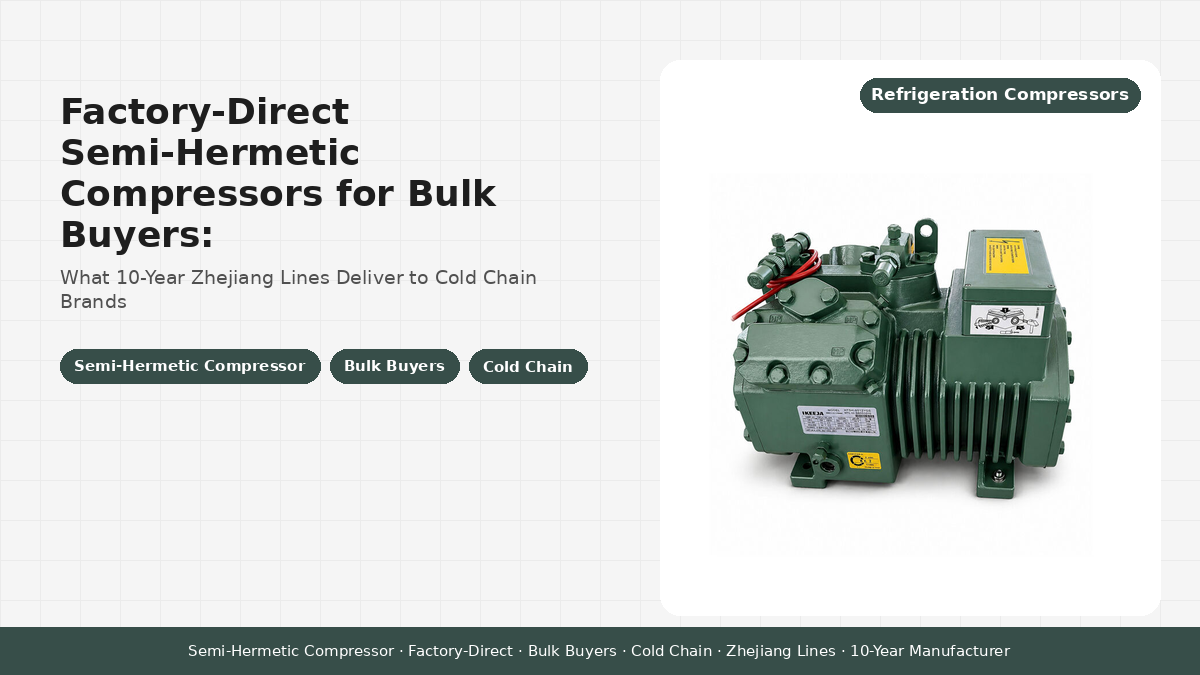
A 5-procurement-consideration comparison of semi-hermetic, hermetic, and open refrigeration compressors for commercial, industrial, and transport applications — covering serviceability, refrigerant compatibility, efficiency, and AHRI / ISO 5149 / ASHRAE 15 compliance.
TL;DR — What a Buyer Should Take Away
- Three designs, three trade-offs. Hermetic is permanently sealed and the lowest-cost; semi-hermetic has a bolted shell that opens for service; open is a separate motor and compressor frame, with the most serviceability. The right choice depends on the duty cycle, the refrigerant, the operating environment, and the service economics.
- Cold storage and industrial refrigeration want semi-hermetic or open. The continuous duty and the high cost of downtime favor the serviceable designs. A hermetic compressor in cold storage means replacing the entire compressor when a single valve fails, which is expensive over the equipment life.
- Transport refrigeration and residential refrigeration want hermetic. The vibration and shock of transport operation, and the cost sensitivity of residential, favor the permanently sealed design. A hermetic compressor fails as a unit, but the swap-out cost is less than the in-field service cost of a serviceable design.
- Refrigerant compatibility is an active procurement consideration. The EU F-gas Regulation and the global Kigali Amendment are phasing down high-GWP HFCs, and the compressor has to be matched to the refrigerant the system uses — including the new low-GWP HFO blends (R454B, R454C) and natural refrigerants (R290 propane, R744 CO2).
- Certification stack is AHRI + ISO 5149 + ASHRAE 15 + IEC 60335 + PED. A serious compressor supplier holds the AHRI performance rating, the ISO 5149 safety certification, the ASHRAE 15 alignment, the IEC 60335-2-34 electrical safety, and the EU Pressure Equipment Directive declaration — all on the specific compressor model being shipped.
For a buyer sourcing refrigeration compressors for a commercial, industrial, or transport program, the choice between semi-hermetic vs hermetic vs open compressor is not a brand preference. It is a system-design decision that drives the equipment's serviceability over the operating life, the refrigerant compatibility, the efficiency at part-load, and the total cost of ownership across the 15-25 year equipment lifetime.
At Weien we supply refrigeration compressors — including the semi-hermetic reciprocating compressor line — from a Zhejiang facility that has been producing compressor spare parts and components compatible with Bitzer, Carrier, Thermo King, Copeland, and other world-leading brands. This guide is written for the refrigeration OEM procurement engineer, the cold-storage contractor, and the transport refrigeration operator who has to pick the right compressor design for a specific application. By the end you should be able to read a compressor spec sheet, identify which design is appropriate for the application, and place an order that delivers the design performance over the equipment life.
How the Three Designs Work
Before walking through the procurement considerations, it helps to internalize how the three designs differ at the mechanical level. The serviceability of the design is what drives the procurement decision, and the serviceability is what the bolted shell, the welded shell, and the separate frame determine.
The hermetic compressor has a permanently welded steel shell that encloses both the motor and the compression element (reciprocating piston, scroll, or rotary). The shell is not intended to be opened for service — when the compressor fails, the entire unit is replaced. Hermetic designs dominate residential refrigeration, light commercial refrigeration, and transport refrigeration, where the cost per unit is the dominant factor and the service economics do not justify a serviceable design.
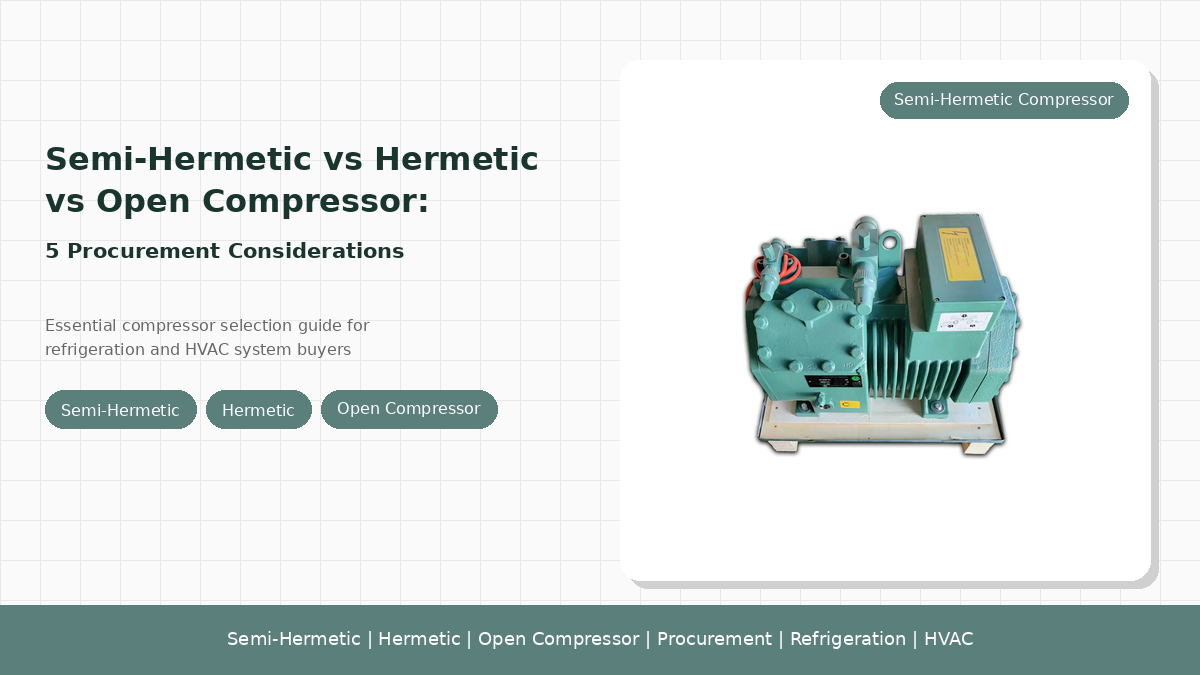
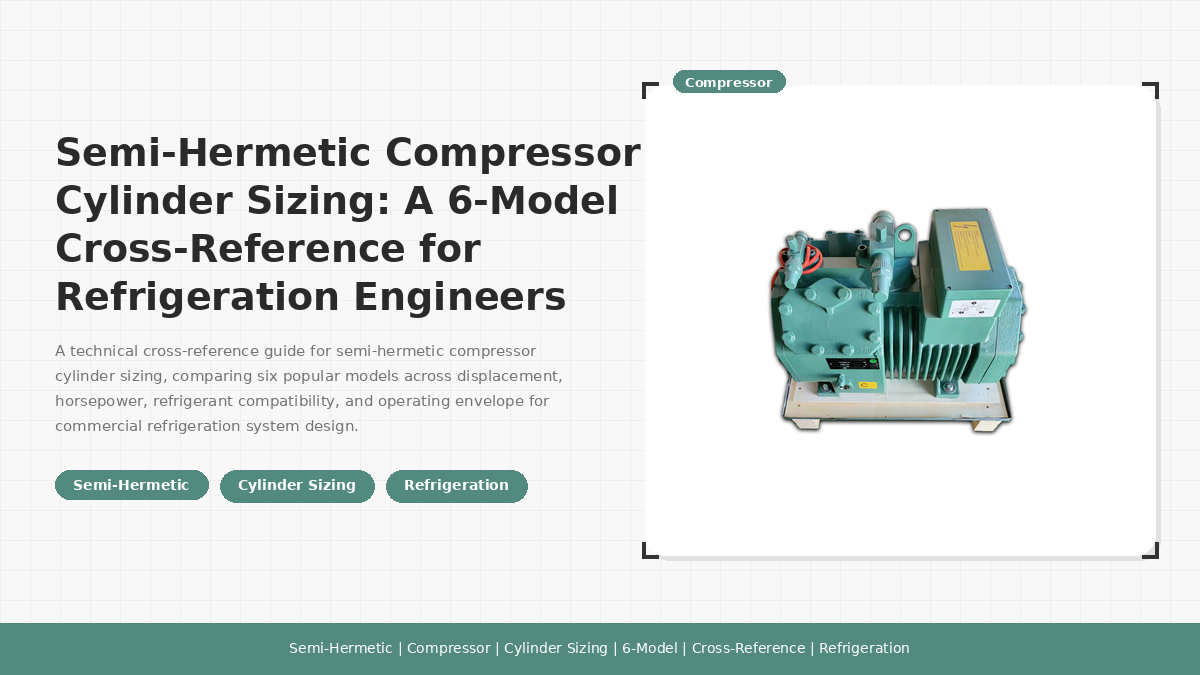
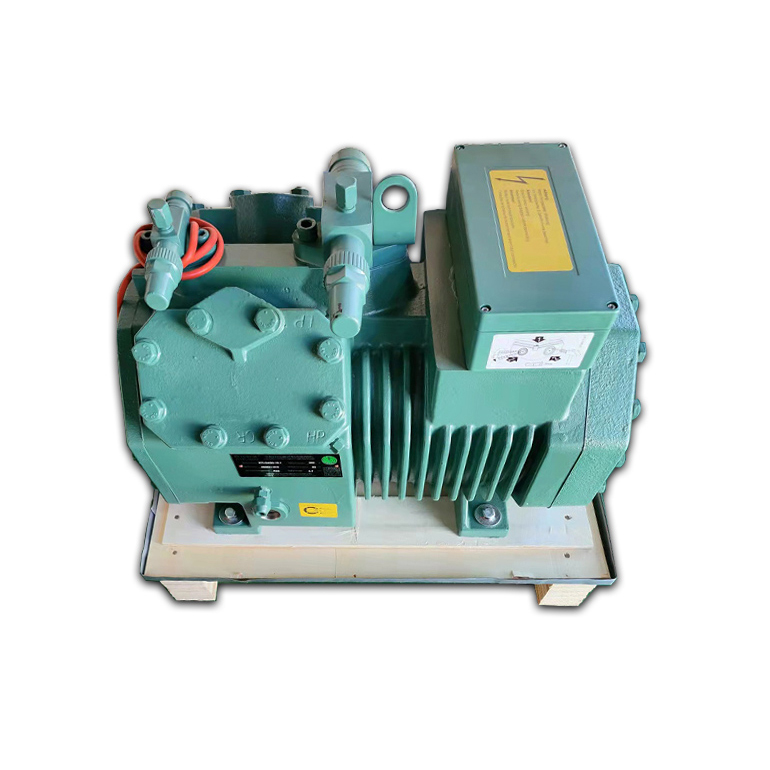
The semi-hermetic compressor has a bolted shell that can be opened by a refrigeration technician for service and overhaul. The bolted joints use a gasket or O-ring seal, and the shell can be re-sealed after the service is complete. A semi-hermetic compressor is overhauled in place by a refrigeration technician with valve kits, piston kits, and bearing kits from the compressor manufacturer, avoiding the cost of replacing the entire compressor when a wearing part fails. Semi-hermetic designs dominate cold storage and medium-to-large commercial refrigeration, where the duty cycle is continuous and the service cost over the equipment life is significant.
The open compressor is a separate motor driving a separate compressor frame via a coupling or belt. Both the motor and the compressor frame are accessible for full service, and the design is used at the largest refrigeration capacities where the size of the compressor frame makes a bolted shell impractical. Open designs dominate industrial process cooling, large-scale cold storage, and chemical refrigeration, where the duty is the most demanding and the serviceability premium is the most valuable. Open compressors are also the most efficient at large capacity, with the largest screw and centrifugal models available only in open configuration.
Consideration 1: Serviceability and Total Cost of Ownership
The serviceability of the design is the most consequential procurement consideration. The total cost of ownership across the 15-25 year equipment lifetime is dominated by the service cost, not the purchase price.
For a hermetic compressor, the service model is replace-not-repair. When the compressor fails, the technician removes the failed unit, installs a replacement, and recovers the refrigerant from the failed unit. The cost of the replacement compressor plus the labor is the service event cost. The failed compressor is typically scrapped because the cost of opening the welded shell, replacing the failed component, and re-evacuating and re-charging the system is comparable to the cost of a new unit.
For a semi-hermetic compressor, the service model is overhaul-in-place. When the compressor fails or shows wear, the technician opens the bolted shell, replaces the failed or worn component (valves, pistons, bearings, or motor windings), re-seals the shell, and re-commissions the system. The cost of the overhaul kit plus the labor is typically 30-50% of the cost of a new unit, and the overhaul is faster than a swap-out because the refrigerant circuit does not have to be fully recovered and re-charged.
For an open compressor, the service model is rebuild-in-place. The motor is a separate component that can be rewound or replaced without touching the compressor frame, and the compressor frame itself can be overhauled with new bearings, seals, and rotors. The service cost is the lowest of the three designs because the parts are accessible and the overhauls are independent.
For a buyer evaluating the three designs, the procurement math is: a semi-hermetic compressor that costs 30-40% more than a hermetic compressor will typically pay back the premium within 3-5 years on a continuous-duty application, because the overhaul cost is 30-50% of the replacement cost. For an open compressor that costs 50-80% more than a semi-hermetic, the payback depends on the duty cycle and the local labor cost for a refrigeration technician.
Consideration 2: Application Match
The application determines the right design. The four primary application segments for refrigeration compressors — cold storage, transport, residential and light commercial, and industrial process cooling — each favor a different design.
Cold storage favors semi-hermetic. The duty cycle is continuous, the downtime is expensive (a cold storage failure can cost thousands of dollars per hour in spoiled product), and the service technician can be on site within hours. Our semi-hermetic reciprocating compressor line covers the typical 3-30 HP range for cold storage, with the bolted shell accessible for valve and piston replacement without removing the compressor from the system.
Transport refrigeration (reefer containers, truck trailers, rail reefer cars) favors hermetic. The vibration and shock of transport operation would damage the bolted joints of a semi-hermetic or open compressor, and the cost of in-field service on a transport unit is so high that swap-out is the practical answer anyway. The transport market also values the lower cost and lower weight of the hermetic design.
Residential and light commercial refrigeration (refrigerators, freezers, ice machines, small display cases) favors hermetic. The cost per unit is the dominant factor and the duty cycle is intermittent. A hermetic compressor is the lowest-cost option at the small end of the capacity range (under 5 HP), and the serviceability premium of a semi-hermetic is not justified for a refrigerator that runs for 15-20 years before being replaced.
Industrial process cooling and chemical refrigeration favors open. The duty is the most demanding and the serviceability premium is the most valuable. Open compressors use a separate motor (typically explosion-proof for chemical service) and a separate compressor frame, with the coupling or belt drive accessible for service. The open compressor is also the most efficient at large capacity, with the largest screw and centrifugal models available only in open configuration.
Consideration 3: Refrigerant Compatibility
Refrigerant compatibility is an active procurement consideration, not a static one. The EU F-gas Regulation and the global Kigali Amendment are phasing down high-GWP HFCs, and the compressor has to be matched to the refrigerant the system uses. The wrong compressor-refrigerant pair fails in service.
The refrigerant families relevant for 2026 procurement are:
- R404A — the dominant low- and medium-temperature commercial refrigerant, with high GWP. Phase-down is in progress in the EU and globally.
- R134a — the dominant medium- and high-temperature commercial and chiller refrigerant, with moderate GWP. Phase-down is in progress.
- R407C — a medium-temperature commercial retrofit refrigerant, with moderate GWP. Still in use but phase-down in progress.
- R290 propane — a low-GWP natural refrigerant gaining share in residential and light commercial. Charge limits apply because propane is flammable.
- R744 CO2 — a low-GWP natural refrigerant used in transcritical commercial refrigeration systems. Higher pressure operation requires different compressor designs.
- HFO blends (R454B, R454C, R452A) — the new low-GWP HFC/HFO blends that are replacing R404A and R407C in many applications. Mildly flammable (A2L classification) requires charge limits and leak detection.
A buyer specifying a compressor should confirm the refrigerant compatibility with the supplier, including the GWP value, the ASHRAE safety classification (A1, A2L, A2, A3, B1, B2L, B2, B3), and any application limits (charge limits for flammable refrigerants, pressure limits for transcritical CO2). The compressor supplier should be able to walk the buyer through the refrigerant compatibility on a case-by-case basis.
Consideration 4: Standards and Certification
The compressor certification stack has three layers: performance rating, safety, and pressure-bearing compliance. Each layer has its own standard body and its own scope.
For performance rating, the dominant US standard is AHRI Standard 540 (performance rating of positive displacement refrigerant compressors) and AHRI Standard 550/590 (performance rating of water-chilling packages using the vapor compression cycle). An AHRI-rated compressor has been tested in an AHRI-accredited laboratory against a published test procedure, and the manufacturer is audited against periodic reports of the test program. The European counterpart is the ISO standards portfolio covering compressor testing (ISO 9179 for positive displacement refrigerant compressors, ISO 13256 for water-source heat pumps), which the EU buyers typically cite alongside AHRI.
For safety, the dominant international standard is ISO 5149 (refrigerating systems and heat pumps — safety and environmental requirements). The ISO 5149 series covers the refrigerant containment, the pressure relief, the electrical safety, and the operating limits of the refrigeration system. The dominant US safety standard is ASHRAE Standard 15 (safety standard for refrigeration systems), which sits alongside the ASHRAE 34 refrigerant safety classification. The dominant international electrical safety standard for motor-compressors is IEC 60335-2-34 (safety of household and similar electrical appliances — particular requirements for motor-compressors). The European national adoptions are published as EN 60335-2-34 with DIN (Germany), BSI (UK), and equivalent bodies across the EU member states.
For pressure-bearing compliance, the EU mandates the Pressure Equipment Directive (PED), which classifies the compressor as a pressure vessel and requires the manufacturer to declare the PED category, the design pressure, and the test pressure. For the EU market, CE marking under the PED is mandatory for any compressor operating above the directive's pressure thresholds.
A serious compressor supplier holds all three layers of certification on the specific compressor model being shipped, and produces the documentation on demand. The supplier should also be able to walk the buyer through the regional certification requirements for the destination market (UL for North America, CE-RED for EU, CCC for China, KC for Korea, PSE for Japan).
Consideration 5: Documentation and Spare Parts Availability
The documentation stack and the spare parts availability are the final procurement considerations, and they determine whether the compressor can be installed, commissioned, serviced, and overhauled over the equipment life.
The minimum documentation package for a compressor shipment is:
- Performance rating certificate — AHRI Standard 540 or equivalent, with the certificate number, the issuing body, the validity period, and the model coverage.
- Pressure-test certificate — for the compressor shell, with the test pressure, the test duration, and the pass criterion. Required for the PED declaration in the EU.
- Refrigerant compatibility declaration — the list of approved refrigerants, with the GWP value and the ASHRAE safety classification for each.
- Electrical data sheet — voltage, frequency, current, power factor, IP rating, insulation class, and ambient temperature range.
- Installation and service manual — the compressor installation, commissioning, and service procedure, in the language of the destination market.
- Spare-parts list with current pricing — the spare parts catalog with current pricing and lead time, because the spare-parts availability is the long-term serviceability question for a semi-hermetic or open compressor.
- Factory acceptance test report — for the specific lot being shipped, with the running test results, the vibration measurement, and the noise measurement.
A buyer who accepts a compressor shipment without the documentation stack is accepting a future service event that the buyer cannot diagnose, troubleshoot, or repair. The documentation is the buyer's leverage for the equipment life.
What Buyers Get Wrong About Compressor Selection
Across the procurement programs we work with, three mistakes show up often enough to flag.
Mistake 1 — defaulting to the lowest-cost design without considering serviceability. The buyer picks the hermetic compressor because it is the cheapest option, without analyzing the cost of the equipment life. A semi-hermetic compressor in cold storage will pay back the premium within 3-5 years on the first overhaul, and the premium is well worth the cost for a continuous-duty application. The right answer is to model the total cost of ownership, not just the purchase price.
Mistake 2 — specifying a compressor without confirming refrigerant compatibility. The buyer orders a compressor and assumes it will work with the refrigerant the system uses, without confirming the GWP value, the ASHRAE safety classification, and any application limits. The wrong compressor-refrigerant pair fails in service, with potentially serious safety consequences for flammable refrigerants like R290 or mildly flammable blends like R454B. The right answer is to confirm refrigerant compatibility with the supplier before the order.
Mistake 3 — ignoring the documentation stack. The buyer accepts the compressor shipment without requesting the AHRI performance certificate, the pressure-test certificate, the refrigerant compatibility declaration, and the spare-parts list. When the compressor fails in service and the buyer needs to source the spare parts, the documentation is missing and the buyer cannot identify the right part. The right answer is to require the documentation stack from the supplier before the order is confirmed.
Where This Connects to Your Specification
Specifying the right compressor design is the first of three decisions a buyer makes. The second is the refrigerant compatibility (the refrigerant the system uses, with the GWP value and the ASHRAE safety classification), and the third is the certification and documentation stack for the destination market. The five procurement considerations above are the framework for the design decision, and the refrigerant and certification decisions usually follow.
If you are at the specification stage and have not yet locked the design, send us your application (cold storage, transport, residential, industrial process cooling), your refrigerant and capacity, your destination market, and your unit volume band. We will return a sample plan across our refrigeration compressor line with per-model pricing, per-refrigerant compatibility, and per-model lead time for your destination port. From there the refrigerant and certification decisions usually fall out cleanly.
Request a Compressor Selection Plan
Send us your application, refrigerant and capacity, destination market, and unit volume. We will return a sample plan across our refrigeration compressor line with per-model pricing, refrigerant compatibility, and lead time for your destination port.
Request a Quote Browse Semi-Hermetic Compressors → All Refrigeration Compressors →